
Object Search Record
Images
Additional Images [3]
Metadata
Catalog Number |
1976.1.4954.1.1 |
Object Name |
Plate, Dinner |
Date |
1800s, early |
Title/Pattern |
Imari-style (no formal pattern name) |
Artist/Author/Creator |
Spode / Copeland's |
Description |
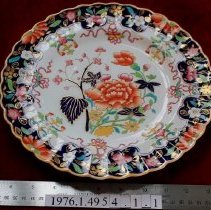
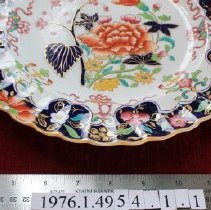
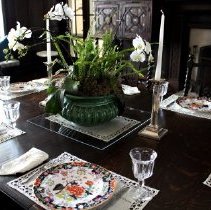
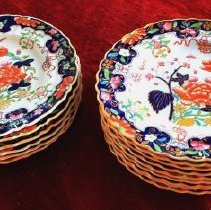
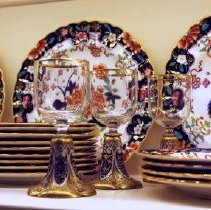
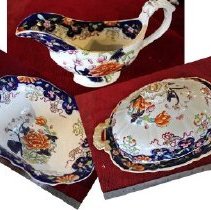
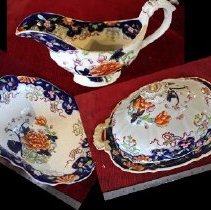
One of 15 dinner plates with fluted rim, in a colorful Imari-style pattern (Imari refers to a multicolor Japanese pattern with elaborate floral designs). The Dining Room table at Blithewold is often set with the Imari dinnerware. It was Marjorie's favorite setting for lunches and dinners. The rich orange color of the chrysanthemums is a foil for the deep blue which matches the chair seats and window seats, the blue wallpaper above the paneling, and the collection of blue and white china on the plate rail. This piece is made of porcelain, painted with flowers, leaves and vines in colors including dark blue, green, rust / orange, yellow pink and gold colors on a white / cream background. The flower types include carnation and daisy shapes. There are decorative ribbons hanging from a pagoda shaped-cover, and scroll-shapes tied into the ribbons. Nine of the 15 plates are made of porcelain, including this one. The other six are made of earthen- or stone-ware. These plates are part of a china set that has about 58 individual pieces including salad plates, bread plates, soup bowls, serving dishes, tureens, and so on. The full set is actually composed of two groups of china, with the same Imari pattern, but appear to have been manufactured and purchased at different times. One set has the Spode Copeland's China maker's mark. These pieces are made of porcelain, have lots of gilding, a white background, a gold/beige painted edge, and the painting quality is bit more refined. The other pieces, without the maker's mark are made of earthenware or stoneware, and appear to be earlier versions. The manufacture and painting seems to be somewhat less refined in quality. The pieces tend to be a bit thicker and taller, but smaller in diameter. These earlier pieces have less gilding, a cream colored background and cream-colored edges. We believe these plates were also made by Spode Copeland's at an earlier time, before their porcelain bone china recipe was perfected. Imariware Japanese porcelain was produced in Southern Japan in the early 1600's. Starting in 1660 it flooded into European markets. European imitations were produced by Meissen and Vincennes followed by other companies including Spode, Copeland and Garrett, Crown Derby and Samuel Radford. Spode started producing c 1805. Imari dominated Spode patterns from 1805-1815. The original colors of red and blue were supplemented with green, yellow and other colors. Gilding, catering to the European tastes, added richness to the ware. After 1818, the Derby factory produced a lower quality product. |
Maker's Information |
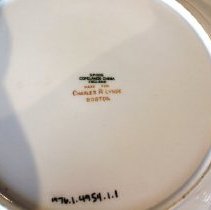
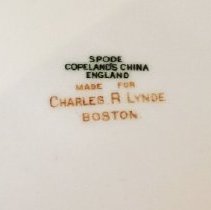
On recessed underside, stamped in green, the mark reads, "SPODE / COPELANDS CHINA/ ENGLAND" Underneath that, in red ink, is the mark "MADE FOR / CHARLES R. LYNDE / BOSTON" |
Materials |
Porcelain/Paint/Ink/Glaze |
Condition |
Good |
Search Terms |
Plate Dinnerware Dining China Flowers Floral Spode Copeland |
Catalog Sub-category |
Food Service T&E |